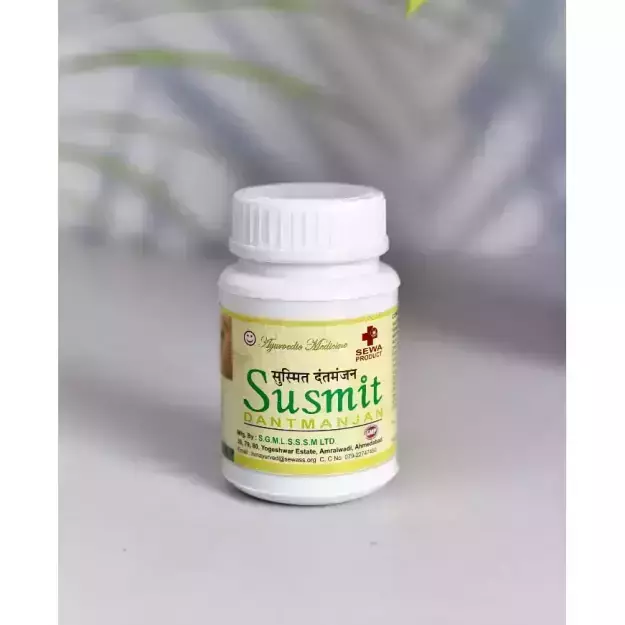
Sewa Susmit Dantmanjan Powder

 8589 people have bought this recently
50 gm Powder in 1 Bottle
₹ 70
50 GM POWDER 1 Bottle ₹ 70

Sewa Susmit Dantmanjan Powder Information

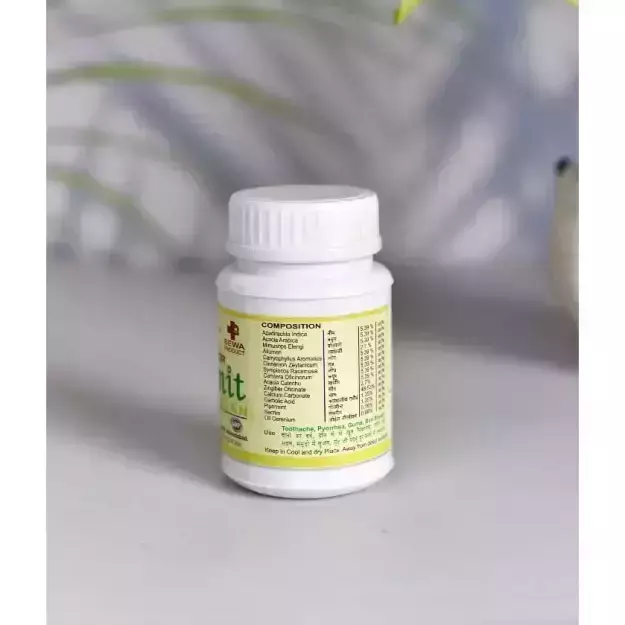
Sewa Susmit Dantmanjan Powder is primarily used for the treatment of Dental Plaque and Toothache. The key ingredients of Sewa Susmit Dantmanjan Powder are Camphor, Clove, Neem, Ginger, Cinnamon, Black Catechu (Khadira), Babool, Calcium Carbonate, Geranium, Bakula and Peppermint Oil. The properties of which have been shared below.

Ingredients of Sewa Susmit Dantmanjan Powder

Camphor
  • Substances that are used to reduce pain
  • Substances that are applied topically to cause local inflammation to help relieve the inflammation of a deeper tissue.
Clove
  • Substances that are employed to avoid sepsis by destroying infectious microbes
  • A medicine or an agent which destroyes or suppresses the growth of bacteria.
  • Drugs used to eliminate microbial pathogens or inhibit their growth.
Neem
  • Agents or substances that are used to suppress inflammation (swelling).
  • Drugs which kill bacteria or inhibit their activities.
  • Agents which are helpful against microbial growth and actions.
  • Agents that provide symptomatic relief in case of an allergic response.
Ginger
  • Drugs which are used for the control of pain and do not lead to loss of consciousness
  • Substances used to reduce the symptoms of fever, pain and swelling in an inflammatory response.
  • Agents which prevent microbial replication and growth by either killing microorganisms or ceasing their actions.
Cinnamon
  • Drugs used to reduce swelling after an injury
  • Substances that are employed to avoid sepsis by destroying infectious microbes
Black Catechu (Khadira)
  • A drug or an agent that reduces pain without causing loss of consciousness.
  • Substances that shrink body tissues and are used to reduce excessive bleeding or open skin pores.
Babool
  • Compounds that reduce the size of skin pores or that contracts body tissues.
  • Drugs that are effective in killing or reducing the growth of bacteria.
Calcium Carbonate
  • Substances that provide nourishment to the body.
Geranium
  • Substances with a strong fragrance
Bakula
  • Agents which prevent microbial replication and growth by either killing microorganisms or ceasing their actions.
Peppermint Oil
  • Agents or substances that are used to suppress inflammation (swelling).

Sewa Susmit Dantmanjan Powder Benefits

Sewa Susmit Dantmanjan Powder is used to treat the following -


Sewa Susmit Dantmanjan Powder Side Effects

No side effects of Sewa Susmit Dantmanjan Powder have been reported in the medical literature. However, you should always consult your doctor before using Sewa Susmit Dantmanjan Powder.


This medicine data has been created by -

Dr. Braj Bhushan Ojha

BAMS, Gastroenterology, Dermatology, Psychiatry, Ayurveda, Sexology, Diabetology
10 Years of Experience


References

Ministry of Health and Family Welfare. Department of Ayush: Government of India. [link]. Volume VI. Ghaziabad, India: Pharmacopoeia Commission for Indian Medicine & Homoeopathy; 2008: Page No CCXLIV-CCXLV

Ministry of Health and Family Welfare. Department of Ayush: Government of India. [link]. Volume 1. Ghaziabad, India: Pharmacopoeia Commission for Indian Medicine & Homoeopathy; 1986: Page No - 110 - 111

Ministry of Health and Family Welfare. Department of Ayush: Government of India. [link]. Volume 2. Ghaziabad, India: Pharmacopoeia Commission for Indian Medicine & Homoeopathy; 1999: Page No - 131 - 135

Ministry of Health and Family Welfare. Department of Ayush: Government of India. [link]. Volume 1. Ghaziabad, India: Pharmacopoeia Commission for Indian Medicine & Homoeopathy; 1986: Page No - 138 -139

Ministry of Health and Family Welfare. Department of Ayush: Government of India. [link]. Volume 1. Ghaziabad, India: Pharmacopoeia Commission for Indian Medicine & Homoeopathy; 1986: Page No - 151 - 152

Ministry of Health and Family Welfare. Department of Ayush: Government of India. [link]. Volume 1. Ghaziabad, India: Pharmacopoeia Commission for Indian Medicine & Homoeopathy; 1986: Page No 29-30