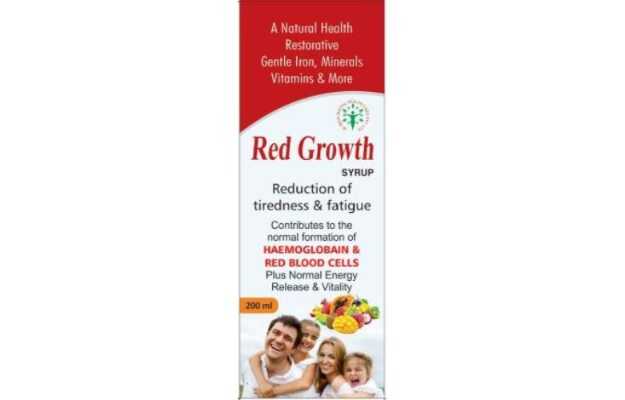
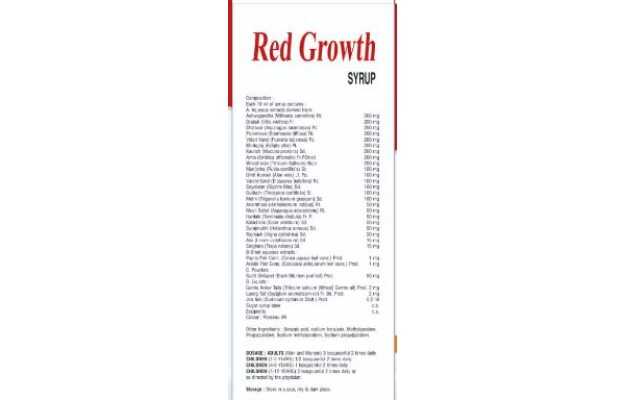
Red Growth Syrup

 8229 people have bought this recently
200 ml Syrup in 1 Bottle
₹ 157 ₹165 4% OFF Save: ₹8
200 ML SYRUP 1 Bottle ₹ 157 ₹165 4% OFF Save: ₹8

  • Seller: JK India Digital Healthcard Pvt Ltd
    • Country of Origin: India

    Red Growth Syrup Information

    Red Growth Syrup is an ayurvedic medicine that is primarily used for the treatment of Fatigue, Weakness, Anemia. The key ingredients of Red Growth Syrup are Ashwagandha, Grapes, Punarnava, Shatavari. The properties of which have been shared below. The correct dosage of Red Growth Syrup depends on the patient's age, gender, and medical history. This information has been provided in detail in the dosage section.

    Ingredients of Red Growth Syrup

    Ashwagandha
    • Plant based compounds that are non-toxic and help regularise overall body functions
    • Drugs used to reduce swelling after an injury
    • Agents which help in reducing free radical activity and preventing oxidative stress and damage
    • Substances that form a protective layer over the mucous membrane and relives inflammation.
    • Drugs which are used to relieve or treat mental depression.
    • Substances that causes you to urinate more frequently to expel extra water from the body.
    • Drugs that act on the immune system to modify immune response
    • Drugs that are used for their actions on the nervous system and are used to calm down excited nerves
    • Supplements that provide proper nutrition to strengthen the body.
    Grapes
    • Agents that reduce inflammation or swelling caused due to an injury or infection.
    • Agents, which help to reduce oxidative stress, by scavenging free radicals
    • Agents that have a favourable effect on liver function and that mitigate liver damage.
    • Agents which prevent microbial replication and growth by either killing microorganisms or ceasing their actions.
    Punarnava
    • Drugs used to reduce swelling after an injury
    • A substance that can inhibit the oxidising effect of free radicals in living cells.
    • Drugs which are helpful in protecting the liver from infections and aid in improving its functions
    • Substances which stimulates the formation of blood and are used for treatment of anaemia.
    • Agents which are helpful against microbial growth and actions.
    Shatavari
    • Substances used to reduce the symptoms of fever, pain and swelling in an inflammatory response.
    • Agents that reduce oxidative stress and revert oxidative damage in the body cells.
    • Agents which are used to relieve depression symptoms.
    • Substances which are used to supress cough and reducing its severity
    • Agents or medicine that acts on the immune system to modulate immunity.
    • Agents that inhibit microbial growth or destroys microbes.
    • Substances produced by one type of microbes and are used for killing or inhibiting the growth of other microbes.
    • Agents that help restore hormonal disturbances in females for the proper functioning of the reproductive system.

    Red Growth Syrup Benefits

    Red Growth Syrup is used to treat the following -


    Red Growth Syrup Dosage

    This is the usual dosage recommended in most common treatment cases. Please remember that every patient and their case is different, so the dosage can be different based on the disease, route of administration, patient's age and medical history.

    Age Group Dosage
    Adult
    • General: Use prescribed amount
    • Before or After Meal: After Meal
    • Single Maximum Dose: 3 Teaspoon
    • Preferred way of taking: LukeWarm Water
    • Dosage Form: Syrup
    • Dosage Route: Oral
    • Frequency: BID (twice daily)

    Red Growth Syrup Side Effects

    No side effects of Red Growth Syrup have been reported in the medical literature. However, you should always consult your doctor before using Red Growth Syrup.


    Red Growth Syrup Related Warnings

    • Is the use of Red Growth Syrup safe for pregnant women?


      It is not known what effect Red Growth Syrup will have during pregnancy, because no research work has been carried out on this till date.

      Unknown
    • Is the use of Red Growth Syrup safe during breastfeeding?


      In the absence of any scientific study of side effects of Red Growth Syrup for breastfeeding women, information on safety of Red Growth Syrup is unavailable.

      Unknown
    • What is the effect of Red Growth Syrup on the stomach?


      Using Red Growth Syrup does not have any harmful effects on the stomach.

      Safe
    • Is the use of Red Growth Syrup safe for children?


      No research has been done regarding the safety of Red Growth Syrup for children. Therefore, it cannot be said if Red Growth Syrup is safe for children.

      Unknown
    • Can I take Red Growth Syrup with alcohol?


      No research has been done on this till date. Therefore, it is not known what the effect of taking Red Growth Syrup with alcohol will be.

      Unknown
    • Does Red Growth Syrup cause drowsiness?


      Red Growth Syrup does not cause dizziness or drowsiness, so you can drive a vehicle or operate machinery also.

      No
    • Is this Red Growth Syrup habit forming or addictive?


      Currently, no research suggests that the use of Red Growth Syrup can lead to addiction.

      No

    General precautions for Red Growth Syrup


    This medicine data has been created by -

    Dr. Braj Bhushan Ojha

    BAMS, Gastroenterology, Dermatology, Psychiatry, Ayurveda, Sexology, Diabetology
    10 Years of Experience


    References

    Ministry of Health and Family Welfare. Department of Ayush: Government of India. Volume- I. Ghaziabad, India: Pharmacopoeia Commission for Indian Medicine & Homoeopathy; 1999: Page No 19-20

    Ministry of Health and Family Welfare. Department of ISM & H: Government of India. [link]. Volume- III. Ghaziabad, India: Pharmacopoeia Commission for Indian Medicine & Homoeopathy; 2001: Page No 45-46

    Ministry of Health and Family Welfare. Department of Ayush: Government of India. [link]. Volume 4. Ghaziabad, India: Pharmacopoeia Commission for Indian Medicine & Homoeopathy; 2004: Page No 122 - 123


    You may also like