

 Download App





What is Androstenedione (A4) test?
Androstenedione is an androgenic hormone - male sex hormone - present in both men and women. It is secreted by testes (and in small amount by adrenal glands) in men and by ovaries and adrenal gland in women.
Despite the title, androstenedione does not have a major androgenic function on its own. Instead, it acts as a precursor for the formation of oestrogen and testosterone. Nonetheless, it is a crucial sex steroid that helps kickstart sexual differentiation in boys and girls. Being primarily androgenic it also plays a role in the development of secondary sexual characteristics in men. These include deep voice and growth of facial hair.
An excess of this hormone leads to hormonal imbalance which manifests in the form of menstrual irregularities in women and excess hairs and changes in genitalia in both genders.
Since it is associated with three glands - adrenal, testes and ovaries, doctors order an androsterone test to assess the functioning of all of these glands.
- Why is Androstenedione (A4) test performed?
- How do you prepare for an Androstenedione (A4) test?
- How is an Androstenedione (A4) test performed?
- Androstenedione (A4) test results and normal range

Why is Androstenedione (A4) test performed?
An androstenedione test is ordered to:
- Diagnose hyperandrogenism (increased levels of androgens)
- Diagnose congenital adrenal hyperplasia (CAH)
- Monitor CAH treatment
- Diagnose premature adrenarche (early signs of androgen action)
Your doctor may also order this test if he or she is trying to:
- Assess adrenal gland functioning
- Detect adrenal tumours or cancers
- Determine the cause behind virilisation (male physical characteristics in females)
- Determine the cause of early puberty in boys
- Evaluateandrogen production
- Assess the functioning of ovaries in women
- Assess the functioning of testicles in men
Furthermore, this test is ordered for people who show symptoms such as excess facial and body hair (hirsutism), acne, absence of menstruation (amenorrhoea) and infertility in women and early puberty in boys.

 Share & Earn

 Embed
Embed
 Link
Link
 Whatsapp
 Facebook
 X
Share & Earn
Embed
Link
Whatsapp
Facebook
X
X
Share & Earn
Embed
Link
Whatsapp
Facebook
X
How do you prepare for an Androstenedione (A4) test?
You do not need to do anything special before this test. However, you may want to wear loose and comfortable clothing, so that the test can be performed easily.
For menstruating women, the doctor will provide specific instructions on when the test can be done.
How is an Androstenedione (A4) test performed?
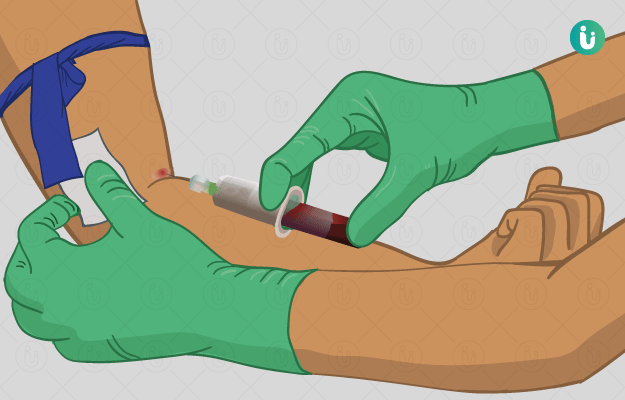
A doctor or laboratory technician will take a small sample of blood from a vein in your arm for this test. This is done using the following steps:
- A healthcare provider will wrap an elastic band around your upper arm to slow the flow of blood in the limb. This will make the veins present below the band swell up so that a needle can be easily inserted
- Next, he/she will clean the injection site with alcohol and withdraw the required amount of blood. You may have no pain at all or just a quick sting or pinch from the needle
- Sometimes, more than one needle insertion may be required
- Once enough blood has been collected, the elastic band will be removed from the arm
The risks associated with this test are:
- Difficulty in obtaining the sample
- Excessive bleeding at the site from where the blood is drawn
- Fainting
- Haematoma (accumulation of blood under the skin)
- Infection at the needle insertion site
Most of these risks can be reduced by following proper precautionary measures.
 Share & Earn
Embed
Link
Whatsapp
Facebook
X
Share & Earn
Embed
Link
Whatsapp
Facebook
X
Share & Earn
Embed
Link
Whatsapp
Facebook
X
Share & Earn
Embed
Link
Whatsapp
Facebook
X
Androstenedione (A4) test results and normal range
Normal androstenedione levels, accompanied by normal levels of other androgens, could be indicative of normal functioning of the adrenal gland. However, it is important to note that in the case of polycystic ovarian syndrome and even adrenal cancer, the level of this hormone may remain normal.
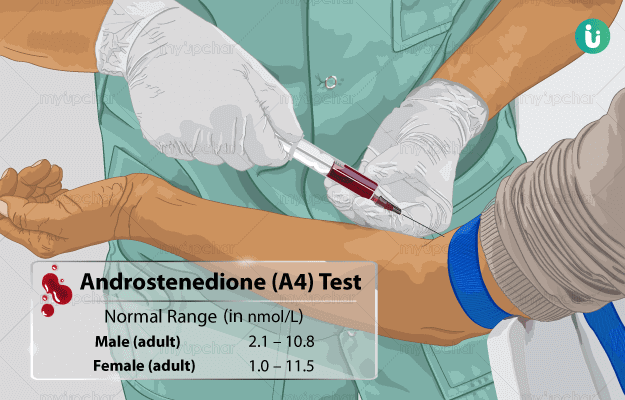
The reference ranges for his test are:
- Male(adult): 2.1 – 10.8 nmol/L
- Female (adult): 1.0 – 11.5 nmol/L
If the test is done to monitor the efficacy of steroid treatment in patients with CAH, normal hormone levels mean that the treatment is effective in controlling excessive androgen production.
A high level of androstenedione indicates:
- Increased production of the hormone in the ovaries, testicles or adrenal glands
- Adrenal tumour
- Adrenal cancer
- CAH
Lower than normal levels of androstenedione may indicate:
- Dysfunction of the adrenal gland
- Failure of the ovaries or testicles
Since an androstenedione test is not diagnostic for any specific condition, doctors usually conduct further tests to determine the exact cause of the symptoms.
Disclaimer: All results must be clinically correlated with the patient’s complaints to make a complete and accurate diagnosis. The above information is provided from a purely educational point of view and is in no way a substitute for medical advice by a qualified doctor.

References
- South Tees Hospitals. NHS Foundation trust. National Health Service, U.K. Androstenedione
- Marx TL, Mehta AE. Polycystic ovary syndrome: Pathogenesis and treatment over the short and long term. Cleve Clin J Med. 2003 Jan;70(1):31-33, 36-41, 45. PMID: 12549723
- Wu A. Tietz Clinical Guide to Laboratory Tests. 4thed. 2006. Saunders Elsevier, St. Louis, MO. Pp: 112-115.
- Pagana KD,Pagana TJ. Mosby’s Diagnostic and Laboratory Test Reference. 10th ed. 2010. Mosby, Inc., St. Louis, MO. Pp: 63-64.
- You and your Hormones [internet]. Society for Endocrinology. Bristol. U.K. Androstenedione